
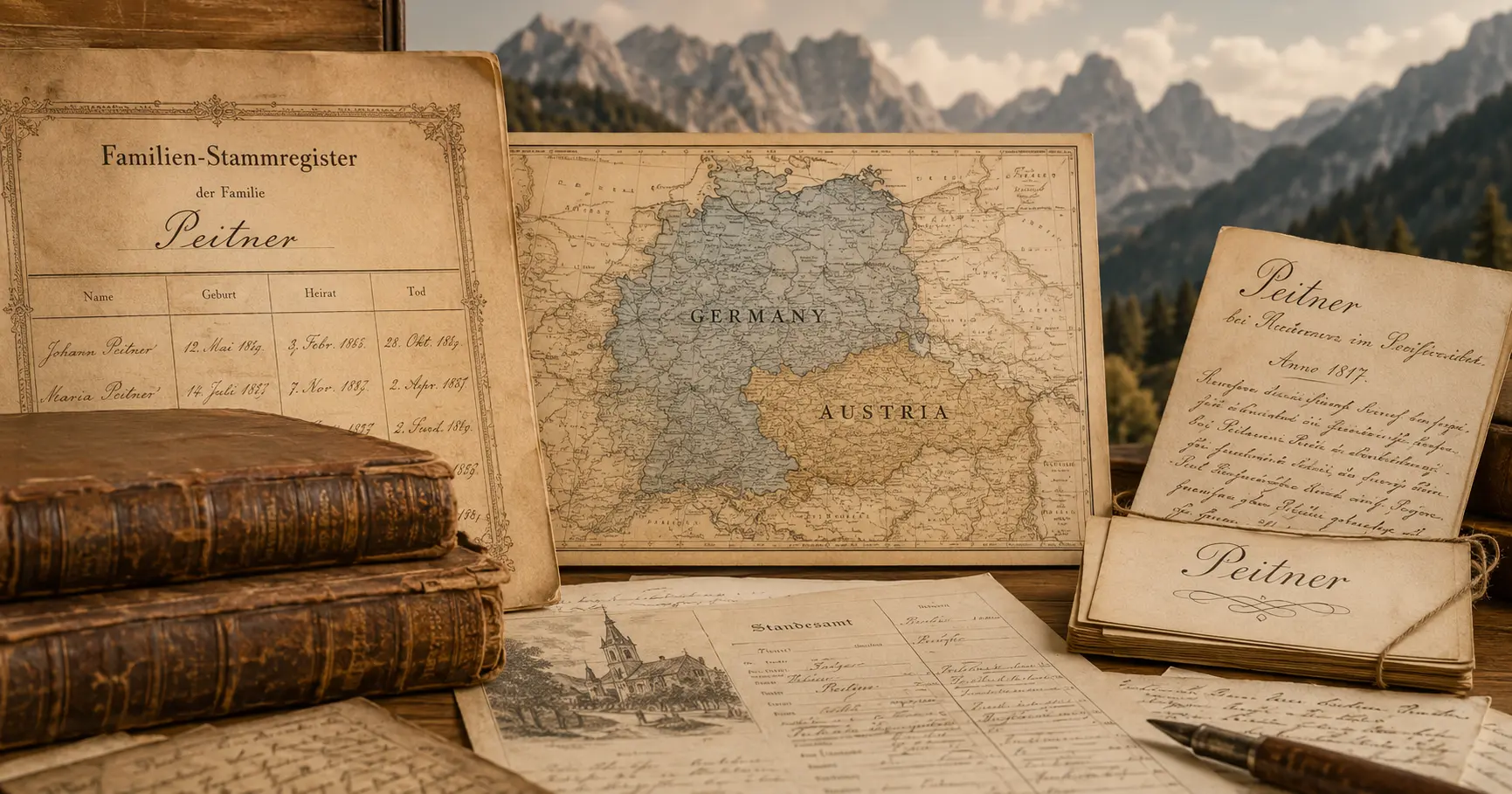
If you came across the name Peitner and wondered what it means, where it came from, or whether it has a connection to your family, you are not alone. Peitner is an uncommon surname, and its unusual spelling naturally raises questions about its history.
The name is mainly associated with German-speaking Central Europe. Historical surname references give more than one possible explanation for it. One connects Peitner with a person who lived near a mountain slope or spur. Another links the name to an Ashkenazic Jewish occupational tradition involving soldering or metalwork.
That makes Peitner more interesting than a simple surname definition might suggest. Its history may involve geography, language, occupation, migration, and changes in spelling over generations.
This guide explains what is actually known about Peitner, where the surname may have originated, what its different meanings could be, and how someone researching a Peitner family can find reliable evidence.
What Does Peitner Mean?
Peitner is primarily a surname rather than a common English word.
According to surname information cited by FamilySearch from the Dictionary of American Family Names, there are two documented explanations for the name.
The first is a German and Austrian explanation. It describes Peitner as a topographic surname connected with someone who lived by a mountain spur or on a mountain slope. The proposed linguistic root is the Middle High German word “līte,” referring to a mountain slope or spur, combined with a suffix indicating an inhabitant.
The second explanation comes from an Ashkenazic Jewish naming tradition. In this case, the name may be an occupational surname connected with the Yiddish word “leytn,” meaning “to solder.” It could therefore have referred to someone who worked with metal or performed soldering work.
These explanations do not necessarily describe one family.
Two unrelated families can develop similar surnames for completely different reasons. This is especially important when researching an uncommon European name because a surname alone cannot prove that two people share the same ancestry.
Is Peitner a German Surname?
Peitner is strongly associated with German-speaking regions, particularly Bavaria and Austria.
Its possible topographic meaning also fits the naming traditions of mountainous areas. In places where hills, slopes, valleys, and mountain spurs were important parts of everyday life, surnames could develop from the landscape surrounding a person’s home.
This does not mean every person named Peitner came from the same village or even from the same family.
German-speaking Europe has a long history of regional dialects and changing spelling practices. A name could be written differently depending on the local language, pronunciation, or the person recording it.
For that reason, genealogy research should not stop when a record contains a spelling slightly different from Peitner.
The Possible Alpine Connection
One of the most interesting aspects of Peitner is its possible connection with the Alpine region.
Bavaria and Austria contain extensive mountainous landscapes. Historically, people were often identified by the location of their homes, farms, or settlements. A geographic feature could become a practical way to distinguish one person from another.
The topographic explanation for Peitner fits this broader European naming pattern.
In simple terms, the name may have described someone who lived near sloping or elevated land.
However, it is important not to turn a possible meaning into a definite family history. The surname’s etymology provides a clue. It does not identify the exact village where an individual ancestor lived.
A Second Possible Origin: Ashkenazic Jewish History
The Peitner surname also has a documented Ashkenazic Jewish explanation.
In this interpretation, the name is associated with the Yiddish word “leytn,” meaning to solder, along with a suffix used to identify the person performing an occupation. The surname could therefore have described a metalworker or someone involved in soldering.
This is an important part of the Peitner story because it shows why assuming a single origin can be misleading.
A family carrying the name Peitner may have a different history from another family carrying exactly the same spelling.
If you are researching your own ancestry, records such as birth certificates, marriage records, immigration documents, census records, and religious records are much more useful than the surname meaning by itself.
Where Is the Peitner Name Found?
Peitner is relatively uncommon compared with many European surnames.
FamilySearch currently shows historical Peitner records across several countries and reports substantial numbers of historical records associated with the surname. Its surname information particularly identifies Hungary, Germany, and Croatia among places where Peitner appears in its collections.
Historical records also show people named Peitner in Germany and the United States.
For example, FamilySearch’s records include Peitner entries from German birth and baptism collections as well as a Peitner record in Boston, Massachusetts.
That does not mean those records all belong to one family line. Instead, they demonstrate how the surname appears in different historical collections and countries.
Peitner in the United States
For Americans researching the surname, immigration history can be especially important.
Many European families changed countries during the 18th, 19th, and 20th centuries. A family that originally lived in a German-speaking region could later appear in American census records, passenger lists, naturalization documents, church records, or military files.
Spelling could also change after immigration.
An official may have written down a name based on how it sounded. A family member may later have simplified the spelling. Different branches of the same family could therefore use slightly different forms.
This is why searching only for the exact spelling “Peitner” may cause you to miss useful records.
Peitner Name Variations
Surname spelling was not always standardized in historical Europe.
You may encounter forms that look similar to Peitner, including:
- Peintner
- Peithner
- Leitner
- Leithner
- Other regional or phonetic spellings
These names should not automatically be treated as interchangeable.
A similar spelling can be an important clue, but it is not proof of a shared family.
When researching an ancestor, compare the person’s location, parents, spouse, occupation, age, religion where relevant, and other identifying details. Several matching facts are much stronger evidence than spelling alone.
Are Peitner and Peintner the Same Name?
They can be related in some historical records, but you should not assume they are always the same surname.
Historical documents sometimes show multiple spellings associated with a family or individual. One recent discussion of Austrian archival material, for example, points to Peithner, Peitner, and Peintner appearing as related forms.
The safest approach is to treat Peintner and Peitner as possible variants during genealogy research rather than automatically declaring them identical.
Look for continuity between records.
If a person appears as Peitner in one census and Peintner in a marriage record, but the birth date, spouse, parents, occupation, and location all match, you may have a strong case that the spelling changed.
What Can the Peitner Surname Tell You About Your Family?
A surname can provide a useful starting point, but it cannot tell your entire family story.
The name may suggest:
- A connection with German-speaking Central Europe
- A possible Alpine or mountainous geographic origin
- A possible occupational connection with soldering in an Ashkenazic Jewish naming tradition
- Historical movement between European regions
- Possible spelling changes across generations
What it cannot prove by itself is:
- Your exact ancestral village
- Your family’s nationality
- Your family’s religion
- Your precise ethnic background
- Whether two Peitner families are related
- When your particular family first adopted the name
Those questions require documentary evidence.
How to Research a Peitner Family
If Peitner is your family name, start with the records closest to you and work backward.
1. Start with known relatives
Write down the full names, birth dates, marriage dates, death dates, and locations of parents, grandparents, and great-grandparents.
Even small details can become important later.
2. Search birth and baptism records
Birth and baptism records can identify parents and sometimes grandparents. They may also provide a place of residence or occupation.
3. Check marriage records
Marriage records are often particularly valuable because they can connect two family groups and may list parents or places of origin.
4. Look for immigration documents
If your Peitner ancestors moved to the United States or another country, search passenger lists, naturalization records, border crossings, and other immigration documents.
5. Search census records
Census records can help establish where a family lived over time. They may also reveal names of relatives living in the same household.
6. Try spelling variations
Do not search only for Peitner.
Also test reasonable variants such as Peintner and Peithner, especially when working with older German or Austrian records.
7. Compare locations
Location is one of the best ways to separate unrelated families.
If one Peitner family appears consistently in Austria while another appears in a completely different region with no documentary connection, they may represent separate family lines.
Why Historical Spelling Matters
Modern spelling can make genealogy look cleaner than it really was.
Today, we expect a surname to be written the same way every time. Historical records did not always work like that.
A priest, clerk, immigration official, census worker, or other record keeper could write a surname according to local pronunciation. Handwriting, language differences, dialects, and simple human error could all affect the spelling.
This is particularly important with uncommon surnames such as Peitner.
A missing letter or an extra letter does not automatically mean you have found a different family.
Is Peitner a Brand, Company, or Technology?
Some recent online pages have presented Peitner as a possible brand, digital concept, software product, or modern business identity.
There is a problem with treating those descriptions as established facts.
The strongest verifiable sources currently identify Peitner as a surname and provide historical surname information. FamilySearch, for example, gives documented linguistic explanations and genealogical records for the name.
That makes the surname interpretation the safest starting point when someone simply searches for “Peitner.”
Of course, a person or company could use Peitner as a brand name. But that would be a modern use of the word, not evidence that the historical surname itself originated as a technology or business term.
Why There Is Confusion Around Peitner
Search results for unusual words can become confusing when different websites publish different explanations without showing where their information comes from.
Some pages describe Peitner broadly as a unique keyword or brand identity. Others claim a single surname origin. Still others introduce explanations that are not supported by established surname references.
The better approach is to separate documented information from speculation.
There is reliable evidence that Peitner exists as a surname. There are also documented explanations connecting it with German/Austrian topographic naming and an Ashkenazic Jewish occupational tradition.
Beyond those points, a specific family history needs to be established through records.
What Makes the Peitner Name Interesting?
Peitner is interesting precisely because it is uncommon and because its history may have developed along more than one path.
The name can point toward the way people were identified in earlier societies.
One explanation ties identity to landscape. A person could be associated with a slope or mountain spur because that was where they lived.
Another explanation ties identity to work. A person involved in soldering or metalworking could acquire an occupational surname.
Both examples show how surnames often grew from ordinary parts of everyday life.
Peitner and Genealogy Today
Modern genealogy makes it easier to investigate rare surnames than it was for previous generations.
Digital archives can help researchers locate old records across countries and decades. Family trees can reveal possible relatives. Census collections and immigration databases can help connect European ancestors with descendants in the United States.
FamilySearch currently reports more than 20,000 historical records associated with the Peitner surname, showing that there is meaningful material available for researchers to explore.
Still, a large database does not automatically make every match relevant.
The goal is not to collect as many Peitner records as possible. The goal is to connect the correct records to the correct family.
Common Mistakes When Researching Peitner
Assuming everyone named Peitner is related
A shared surname is not enough to establish a family relationship.
Trusting one spelling
Historical documents may contain variants. Search broadly.
Treating surname meaning as proof
A surname dictionary can explain possible origins, but it cannot prove your ancestor lived in a particular location.
Ignoring immigration records
For American families, migration documents may provide the link between a U.S. ancestor and an earlier European generation.
Accepting unsupported online claims
If a website describes Peitner as a product, platform, or concept, look for independent evidence before treating that description as fact.
Frequently Asked Questions About Peitner
What is Peitner?
Peitner is an uncommon surname associated with Central European and Ashkenazic Jewish naming traditions. Established surname references give more than one possible origin.
What does the surname Peitner mean?
One documented explanation connects the name with a person who lived near a mountain slope or spur. Another Ashkenazic Jewish explanation connects it with soldering or metalworking.
Is Peitner a German name?
Peitner has documented connections with German and Austrian naming traditions, particularly in Bavaria and Austria.
Is Peitner a Jewish surname?
It can be. FamilySearch’s surname reference includes an Ashkenazic Jewish explanation connected with an occupational term for soldering. However, that does not mean every Peitner family has Jewish ancestry.
Is Peitner a rare surname?
Yes. Peitner is much less common than many German surnames, although historical databases contain thousands of records associated with the name.
Are Peitner and Peintner related?
They may be related in particular family records, and historical spelling variations can occur. However, similar spelling alone does not prove that two families share an ancestor.
Where does the Peitner surname come from?
The strongest documented explanations point toward German/Austrian topographic naming and a separate Ashkenazic Jewish occupational tradition.
Can the Peitner surname reveal my exact ancestry?
No. The surname can provide useful clues, but exact ancestry requires birth, marriage, death, immigration, census, religious, and other historical records.
How can I research my Peitner ancestors?
Begin with your most recent known relatives, then work backward through birth, marriage, census, immigration, and other records. Search for spelling variations as well as the exact Peitner spelling.
Final Thoughts
Peitner is a rare surname with a history that cannot be reduced to one simple definition.
The strongest available evidence gives two important possibilities. In German and Austrian naming traditions, Peitner may have been a topographic name for someone who lived near a mountain slope or spur. In an Ashkenazic Jewish context, it may have developed as an occupational surname connected with soldering.
For anyone researching a Peitner family in the United States or elsewhere, the most important lesson is to treat the surname as a starting point, not a final answer.
Look at the people behind the name. Follow their locations, relatives, occupations, immigration records, and historical documents. Compare spelling variations and confirm each connection before moving to the next generation.
That approach can turn an unusual name like Peitner from a simple search query into a meaningful path toward understanding family history.